Pizza nutrition data, without the mystery
Every reference number used by our pizza calculators, its serving unit, its current evidence status, and the method required before we call it verified.
Dataset version 0.2.0 · Last reviewed August 25, 2026 · Maintained by SwapMyCraving editorial review
First reproducible calculation: egg-white personal pizza
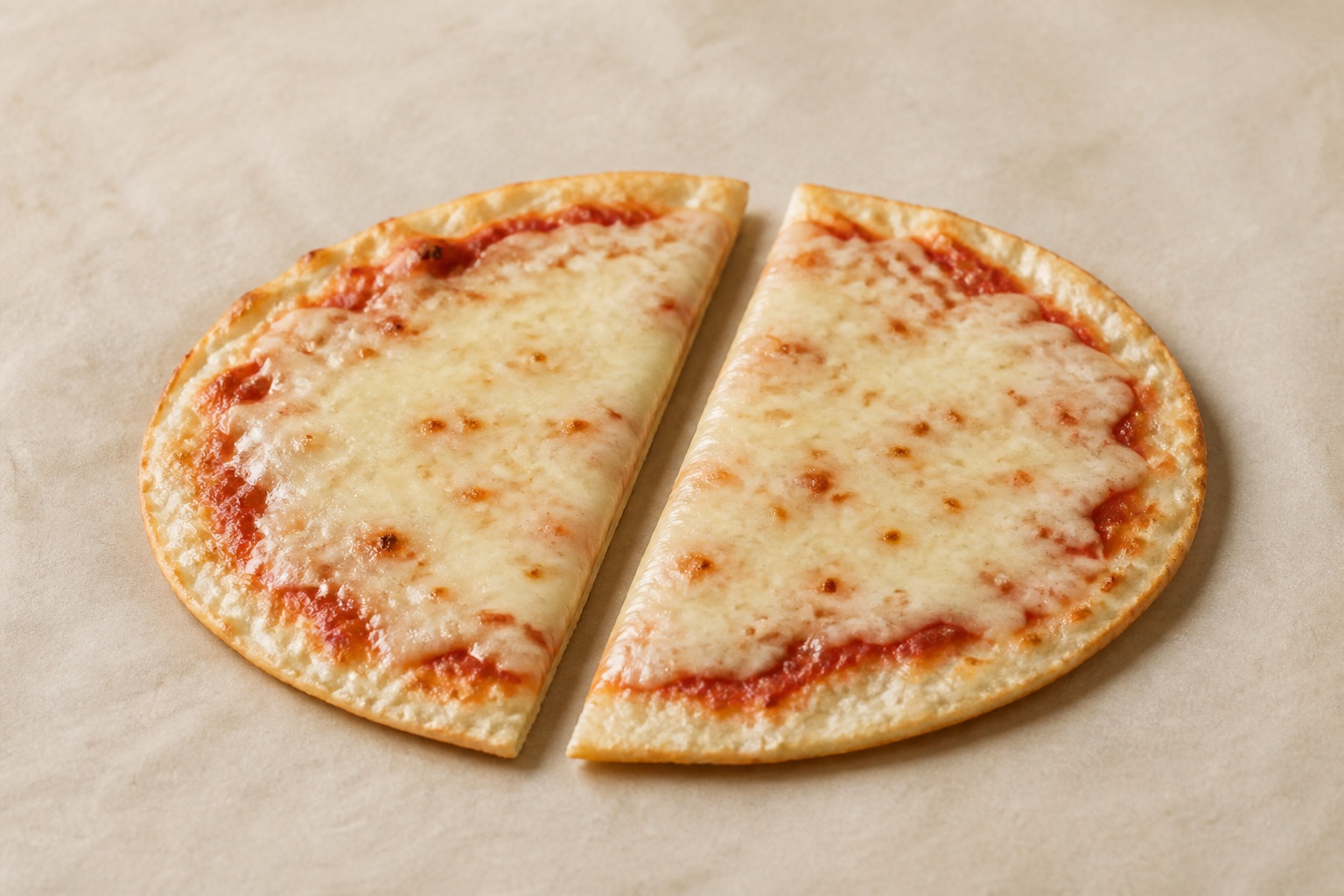
Calculation-backed Recipe version 0.1-calculated. This is the first entry with frozen ingredient weights, named source records, and arithmetic that another reader can reproduce. It has not been kitchen-tested, weighed after cooking, photographed, or reviewed as a physical serving, so it is not a verified recipe.
Ingredient inputs and arithmetic
| Ingredient | Weight | Source per 100g | Contribution to recipe |
|---|---|---|---|
| Raw fresh egg white · FDC 172183 | 200g | 52 kcal · 10.9g protein · 0.73g carbs · 0.17g fat | 104 kcal · 21.8g protein · 1.46g carbs · 0.34g fat |
| Low-moisture part-skim mozzarella · FDC 329370 | 56g | 298 kcal · 23.7g protein · 4.44g carbs · 20.4g fat | 166.88 kcal · 13.272g protein · 2.4864g carbs · 11.424g fat |
| No-salt-added tomato sauce · FDC 169074 | 60g | 24 kcal · 1.2g protein · 5.31g carbs · 0.3g fat | 14.4 kcal · 0.72g protein · 3.186g carbs · 0.18g fat |
Example formula: mozzarella calories = 56 ÷ 100 × 298 = 166.88 kcal. The same operation is applied to protein, total carbohydrate, and fat for every ingredient; contributions are summed before display rounding.
Draft preparation protocol
- Whisk 200g raw egg white until foamy and spread it as one thin personal-pizza base on a lined pan.
- Bake until the egg-white base is fully set. Temperature and time remain deliberately unspecified until a kitchen test records them.
- Top with 60g tomato sauce and 56g low-moisture part-skim mozzarella, then heat until the cheese melts.
- Cut the finished pizza into two equal halves. Record cooked yield, each half's weight, photos, preparation time, and reviewer before physical verification.
Why this does not replace the calculator yet: the old provisional slice was 140 calories, 18g protein, 4g carbs, and 4g fat. The calculated half is close on calories, protein, and carbohydrate, but is about 6g fat. That mismatch and the missing physical-serving evidence keep the calculator entry provisional.
The current reference dataset
These values are useful for rough planning only. Keep the serving unit attached to every number, and use a current package or restaurant label whenever one exists.
| Option | Reference unit | Calories | Protein | Total carbs | Fat | Status |
|---|---|---|---|---|---|---|
| Cauliflower crust pizza | labeled slice | 220 | 14g | 6g | 16g | Provisional |
| Portobello pizza boat | one filled large cap | 150 | 10g | 8g | 8g | Provisional |
| Chicken crust pizza | labeled slice | 200 | 22g | 2g | 11g | Provisional |
| Whole-wheat tortilla pizza | one personal tortilla pizza | 180 | 12g | 18g | 8g | Provisional |
| Fathead keto crust | labeled slice | 280 | 14g | 5g | 22g | Provisional |
| Egg-white pizza crust | labeled slice | 140 | 18g | 4g | 4g | Provisional |
| Bell-pepper pizza boat | one filled half pepper | 150 | 10g | 7g | 8g | Provisional |
| Lavash flatbread pizza | one personal lavash pizza | 200 | 12g | 22g | 6g | Provisional |
Download the machine-readable JSON →
What “verified” will mean here
Freeze a recipe version
Record every ingredient in grams, the cooked yield, number of servings, serving name, and preparation method.
Attach a dated source
Use the exact current product label first. For a homemade ingredient, record the USDA FoodData Central ID and data type.
Keep raw precision
For each nutrient: weight g ÷ 100 × source value per 100g. Sum ingredients, divide by declared yield, then round only for display.
Check the physical serving
Rebuild the recipe, photograph the full yield and one serving, verify the serving count, and log who reviewed the result and when.
Evidence labels
- Verified recipe: ingredients, gram weights, source IDs, calculation, yield, and review evidence are all present.
- Calculation-backed: ingredient weights, source values, and arithmetic are reproducible, but at least one physical evidence field—such as cooked yield, serving weight, photo, kitchen test, or reviewer—is missing.
- Label-backed: the value comes from a current manufacturer or restaurant label for the exact stated serving.
- Provisional: a planning estimate remains useful, but at least one required evidence field is missing. All eight current entries are in this state.
Official source registry
These records are registered as ingredient inputs for recipe reconstruction. Three are now attached to the calculation-backed egg-white model above; that arithmetic still does not validate a calculator total until the prepared recipe and serving yield are physically checked.
Source policy and limitations
- A current official manufacturer or restaurant label overrides any generic value on this site.
- For defined homemade recipes, we prefer USDA FoodData Central. Its data-type documentation explains why records can differ by source and purpose.
- The FDA label guide is our serving-size rule: nutrient values belong to the serving stated on the label, and serving size is not a recommendation.
- Total carbohydrate is shown unless the exact label or recipe supplies fiber. We do not infer universal net carbs.
- This is not medical advice, a laboratory analysis, or proof of weight-loss or ketosis outcomes.
Verification queue
The egg-white personal pizza now has a calculation-backed v0.1 entry. Its next gate is a real kitchen test with cooked yield, serving weights, photos, time/temperature notes, and a named reviewer. Portobello boat, chicken crust, and cauliflower crust remain queued because they anchor the site's vegetable-base, higher-protein, and lower-carb comparisons.
Change log
- 2026-08-25 · v0.2.0: Added the first reproducible ingredient-weight calculation for an egg-white personal pizza. It remains calculation-backed, not verified, and does not replace the calculator's provisional value.
- 2026-08-25 · v0.1.0: Published the first evidence ledger, machine-readable dataset, evidence labels, calculation rule, and ten official candidate ingredient records. No recipe was upgraded to verified.